
Guide: What Do Muslims Believe?
Muslims believe in one God, known in Arabic as Allah, and believe that Muhammad ﷺ is His final messenger. Islam teaches that the same God sent prophets throughout history, including Adam, Noah, Abraham, Moses and Jesus, calling people to worship Him alone.
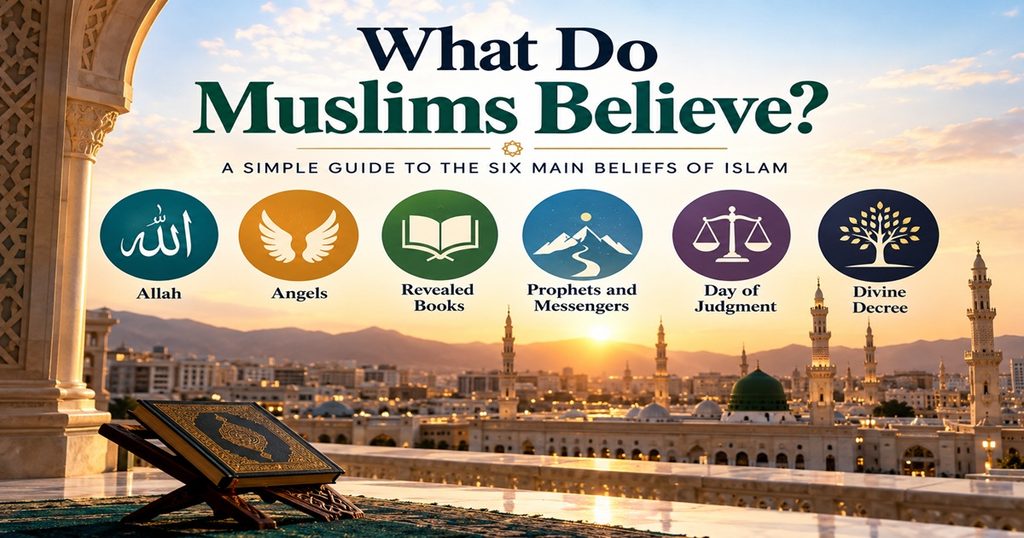
The basic beliefs of Islam are often summarised as six articles of faith: belief in Allah, His angels, His revealed books, His messengers, the Last Day and divine decree.
These beliefs form the foundation of a Muslim’s faith and shape how Muslims understand God, life, death and what comes after it.
1. Belief in Allah
Muslims believe in one God, Allah, who created and sustains everything that exists. He has no partners, children or equals, and He alone is worthy of worship.
Muslims believe that Allah is all-knowing, all-powerful and merciful. Nothing in creation is like Him.
The Qur’an says:
“Say, ˹O Prophet,˺ ‘He is Allah—One ˹and Indivisible˺; Allah—the Sustainer ˹needed by all˺. He has never had offspring, nor was He born. And there is none comparable to Him.’”
Belief in Allah is at the centre of Islam. Muslims direct their prayers and worship to Him alone and believe that every person will ultimately return to Him.
For a more detailed explanation, read Who Is Allah?.
2. Belief in the Angels
Muslims believe that angels are creations of Allah. They carry out the duties Allah gives them and do not disobey His commands.
The Qur’an mentions angels performing different roles. For example, the angel Jibril (Gabriel) brought Allah’s revelation to the prophets, including the Qur’an to Prophet Muhammad ﷺ.
The Qur’an says:
“Whoever is an enemy of Gabriel should know that he revealed this ˹Quran˺ to your heart by Allah’s Will…”
Source: Qur’an 2:97
Muslims do not worship angels or believe that they have divine powers of their own. They are servants of Allah and part of the unseen creation that Muslims are commanded to believe in.
3. Belief in the Revealed Books
Muslims believe that Allah sent revelation to His prophets as guidance for humanity. The Qur’an mentions several scriptures, including the Torah given to Moses, the Psalms given to David, the Gospel given to Jesus, and the Qur’an revealed to Muhammad ﷺ.
The Qur’an says:
“He has revealed to you ˹O Prophet˺ the Book in truth, confirming what came before it, as He revealed the Torah and the Gospel.”
Source: Qur’an 3:3
Muslims believe the Qur’an is Allah’s final revelation and that Allah has promised to preserve it.
The Qur’an states:
“It is certainly We Who have revealed the Reminder, and it is certainly We Who will preserve it.”
Source: Qur’an 15:9
For Muslims, the Qur’an is the primary revealed scripture followed today and provides guidance about faith, worship, morality and how a person should live.
4. Belief in the Prophets and Messengers
Muslims believe that Allah sent prophets and messengers to guide humanity. Their central message was to worship Allah alone and follow His guidance.
The Qur’an mentions many prophets, including Adam, Noah, Abraham, Moses, David, Solomon, Jesus and Muhammad (peace be upon them).
Muslims believe in all of Allah’s prophets and do not reject earlier prophets simply because they came before Muhammad ﷺ.
The Qur’an says:
“We make no distinction between any of His messengers.”
Source: Qur’an 2:285
Muslims believe that Jesus (Isa) was the Messiah and a messenger of Allah, but they do not worship him or regard him as God. They also believe that Muhammad ﷺ is the final prophet and messenger.
The Qur’an states:
“Muhammad is not the father of any of your men, but is the Messenger of Allah and the seal of the prophets.”
Source: Qur’an 33:40
Belief in the prophets connects Islam with the earlier prophetic tradition and teaches that the call to worship one God was not introduced by Muhammad ﷺ, but was the message delivered by prophets throughout human history.
5. Belief in the Day of Judgment
Muslims believe that life in this world is temporary and that every person will eventually be resurrected and held accountable before Allah.
On the Day of Judgment, people will be judged for what they believed and what they did during their lives. Islam teaches that Allah is perfectly just and that no good or bad deed is overlooked.
The Qur’an says:
“So whoever does an atom’s weight of good will see it. And whoever does an atom’s weight of evil will see it.”
Source: Qur’an 99:7–8
Muslims believe in Paradise (Jannah) and Hell (Jahannam) and that the final outcome belongs to Allah’s judgment.
Belief in the Day of Judgment reminds Muslims that their choices have consequences beyond this life and encourages them to worship Allah, do good, seek forgiveness and treat others justly.
6. Belief in Divine Decree
Muslims believe in divine decree (Qadr) — that Allah has complete knowledge of everything that has happened, is happening and will happen.
Nothing is hidden from Allah’s knowledge. At the same time, people are responsible for the choices they make and will be accountable for their actions.
The Qur’an says:
“Indeed, We have created everything perfectly according to a plan.”
Source: Qur’an 54:49
Belief in divine decree means Muslims trust that whatever happens is within Allah’s knowledge and permission, even when they do not understand the wisdom behind it.
This belief encourages Muslims to rely upon Allah while still making choices, taking action and accepting responsibility for what they do.
How These Beliefs Shape a Muslim’s Life
The six articles of faith are not simply beliefs that Muslims learn or memorise. They influence how Muslims understand their purpose and how they try to live.
Belief in Allah encourages Muslims to worship Him alone and turn to Him for guidance. Belief in the Day of Judgment reminds them that their actions matter, while belief in divine decree encourages patience and trust in Allah during both ease and difficulty.
These beliefs are reflected in everyday Islamic practices such as prayer, charity, fasting, seeking forgiveness, being honest and treating others fairly.
The Qur’an describes the purpose of human life:
“I did not create jinn and humans except to worship Me.”
Source: Qur’an 51:56
In Islam, worship is not limited to prayer. Good actions done sincerely for Allah can also be acts of worship. This means a Muslim’s faith is intended to influence both their relationship with Allah and the way they live their everyday life.
Do Muslims Believe in Jesus?
Yes. Belief in Jesus (Isa) is part of Islam, and Muslims believe that he was one of the great messengers of Allah.
Muslims believe that Jesus was the Messiah, was born miraculously to the Virgin Mary (Maryam), and performed miracles by Allah’s permission.
The Qur’an says:
“The Messiah, Jesus, son of Mary, was only a messenger of Allah and the fulfilment of His Word through Mary and a spirit ˹created by a command˺ from Him.”
Source: Qur’an 4:171
Islam differs from Christianity in its understanding of who Jesus is. Muslims do not believe that Jesus is God or the son of God. They worship Allah alone, whom they believe Jesus also called people to worship.
Muslims also believe that Jesus will return before the Day of Judgment.
Because of his importance in Islam, Jesus is mentioned many times in the Qur’an, and Mary has an entire chapter of the Qur’an named after her: Surah Maryam (Chapter 19).
Do Muslims Believe in Moses and the Earlier Prophets?
Yes. Muslims believe in Moses (Musa), Abraham (Ibrahim), Noah (Nuh), David (Dawud), Solomon (Sulayman) and many other prophets mentioned in the Qur’an.
Islam teaches that Allah sent messengers to different peoples throughout history. Although their laws could differ, their fundamental call was the same: worship Allah alone and follow His guidance.
The Qur’an says:
“We surely sent a messenger to every community, saying, ‘Worship Allah and shun false gods.’”
Source: Qur’an 16:36
Moses is particularly important in Islam and is mentioned frequently throughout the Qur’an. Muslims believe Allah spoke to Moses and gave him the Torah.
Muslims therefore see Muhammad ﷺ as part of a long line of prophets, rather than the founder of an entirely new belief in God. Islam teaches that Muhammad ﷺ was the final messenger, confirming the fundamental message taught by the prophets before him.
What Is the Main Belief in Islam?
At the centre of Islam is Tawhid — the belief that Allah is One and that only He deserves worship.
Muslims believe that Allah created everything, has no partner or equal, and does not share His divinity with anyone. Prayer, reliance, and acts of worship are therefore directed to Allah alone.
The Qur’an says:
“Your God is only One God. There is no god ˹worthy of worship˺ except Him—the Most Compassionate, Most Merciful.”
Source: Qur’an 2:163
This belief is expressed in the first part of the Shahada, the declaration of faith:
“There is no god worthy of worship except Allah.”
The second part affirms that Muhammad ﷺ is the Messenger of Allah.
Together, these words express the foundation of Muslim belief and are the declaration a person makes when becoming a Muslim.
What Do Muslims Not Believe?
Understanding Muslim beliefs can also be easier by clearing up a few common misconceptions.
Muslims do not worship Muhammad ﷺ. They believe he was a human being and the final messenger of Allah. Muslims follow his teachings but direct their worship to Allah alone.
Muslims also do not worship the Kaaba in Makkah. The Kaaba is the direction Muslims face during prayer, providing Muslims around the world with a common direction of worship. The prayer itself is directed to Allah.
Islam also rejects the idea that Allah has partners, children or equals.
The Qur’an says:
“So do not knowingly set up equals to Allah.”
Source: Qur’an 2:22
These teachings return to the central principle of Islam: worship belongs to Allah alone.
What Is the Difference Between Belief and Practice in Islam?
Islam includes both what a Muslim believes and how a Muslim worships and lives.
The six articles of faith describe the foundations of Muslim belief: belief in Allah, the angels, the revealed books, the messengers, the Day of Judgment and divine decree.
Muslims also practise their faith through the Five Pillars of Islam:
- Shahada — declaring that there is no god worthy of worship except Allah and that Muhammad ﷺ is His messenger.
- Salah — performing the five daily prayers.
- Zakat — giving obligatory charity when its conditions are met.
- Sawm — fasting during the month of Ramadan.
- Hajj — making the pilgrimage to Makkah for those who are able.
Belief and practice are therefore closely connected in Islam. A Muslim believes in Allah and His guidance and tries to reflect that belief through worship, good character and everyday actions.
The Qur’an frequently connects faith with righteous deeds, showing that Islam is not only about what a person believes internally, but also how that belief affects the way they live.
Can Anyone Become a Muslim?
Yes. Islam is open to people of every nationality, ethnicity and background. A person does not need to be born into a Muslim family to become a Muslim.
To embrace Islam, a person sincerely believes that there is no god worthy of worship except Allah and that Muhammad ﷺ is the Messenger of Allah and declares this belief through the Shahada (declaration of faith).
Becoming Muslim does not require a person to know everything about Islam beforehand. Learning about prayer, the Qur’an and other aspects of the faith can continue after accepting Islam.
The Qur’an says:
“Whoever does good, whether male or female, and is a believer, We will surely bless them with a good life…”
Source: Qur’an 16:97
If you believe in the message of Islam and are considering taking the next step, read our [How to Become a Muslim] guide for a simple explanation of the Shahada and what to do next.
Summary: What Do Muslims Believe?
Muslims believe in one God, Allah, and believe that He alone deserves worship. The foundations of Muslim faith are summarised in six main beliefs:
- Allah
- His angels
- His revealed books
- His prophets and messengers
- The Day of Judgment
- Divine decree
Muslims believe that Allah sent prophets throughout history, including Abraham, Moses and Jesus, and that Muhammad ﷺ is the final messenger. They believe the Qur’an is Allah’s final revelation and that every person will ultimately return to Allah and be accountable for their actions.
At its heart, Islam calls people to worship the Creator alone, follow His guidance and live a life of faith and good deeds.
If you are learning about Islam for the first time, you may also want to read What Is Islam?, Who Is Allah? and How to Become a Muslim.
Frequently Asked Questions About Muslim Beliefs
Do Muslims believe in one God?
Yes. Muslims believe there is only one God, Allah, who created everything and alone deserves worship. This belief is known as Tawhid.
Do Muslims believe in Jesus?
Yes. Muslims believe Jesus (Isa) is the Messiah and one of Allah’s messengers. They believe in his miraculous birth and miracles performed by Allah’s permission, but they do not believe Jesus is God or the son of God.
Do Muslims believe in the Bible?
Muslims believe Allah originally revealed scriptures to earlier prophets, including the Torah and the Gospel. Muslims follow the Qur’an as Allah’s final revelation.
Do Muslims believe in heaven and hell?
Yes. Muslims believe in Paradise (Jannah) and Hell (Jahannam) and that people will be resurrected and judged by Allah after death.
Do Muslims believe in angels?
Yes. Muslims believe angels are creations of Allah who carry out the duties He gives them. Jibril (Gabriel) is especially known for bringing revelation to the prophets.
Do Muslims believe Muhammad is God?
No. Muslims believe Muhammad ﷺ was a human being and the final messenger of Allah. Muslims worship Allah, not Muhammad.
What are the six main beliefs of Islam?
They are belief in Allah, His angels, His revealed books, His messengers, the Day of Judgment and divine decree (Qadr).